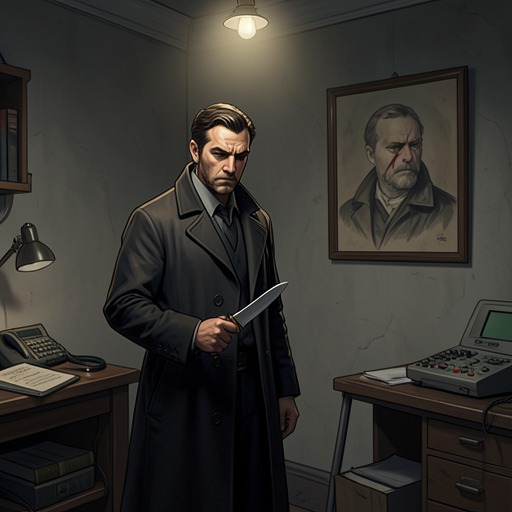
Carl Vespa beats Wade Larue after his admission
Just One LookCarl Vespa beats Wade Larue after Larue admits that he fired the two shots associated with the night Carl’s son died. The violence gives immediate form to Carl’s demand for balance, but it does not settle his grief: Larue says he did not shoot Carl’s son, then offers to tell him what he knows so that the truth, rather than another blow, can decide what happens next.
Background and Stakes
The confrontation follows Wade Larue’s release after fifteen years in prison. Carl has come to face him over the shooting that killed his son, Ryan Vespa. Larue had confessed, but when Carl asks whether he meant it, Larue says that at the time he did not. He then frames the question more precisely: Carl wants to know whether he fired the two shots that night. Larue answers that, either way, he did not shoot Carl’s son. His distinction leaves Carl with a partial admission and an unresolved central question: firing the shots is not the same as killing Ryan.
Carl asks whether Larue is doing this for himself or for his son. Carl says it is not for himself; when Larue presses him about his son, the exchange turns toward the losses that shape the encounter. Carl insists that the world needs balance and that, because eighteen people died, someone has to pay. The number gives his claim a wider scale than a private grievance, even as the scene makes clear that Ryan’s death is the loss directly binding these two men.
The Assault
Larue eventually answers yes when Carl asks whether he fired the shots. Carl’s temper changes abruptly into action: he strikes Larue, who falls, then continues the beating after Larue gets back up. Larue does not answer the blows with an attempt to fight back. He asks whether the attack has given Carl balance. Carl replies that it is a start. The exchange makes the assault more than an outburst: Carl names it as the beginning of a reckoning, while Larue tests whether physical retaliation can actually satisfy the demand behind it.
Larue’s response complicates the role Carl has assigned him. He says that he too once craved revenge, but now no longer wants it. He has spent fifteen years in prison; his sentence is over, he says, while Carl’s will never end because Carl’s son remains dead. As Larue speaks, Carl’s anger gives way to grief. The scene’s contrast is not between a guilty man and an innocent one—Larue acknowledges that he fired shots—but between a punishment that has ended and a loss that cannot be reversed.
From Retaliation to Disclosure
Even while Carl is striking him, Larue asks to be allowed to talk. After Carl steps back, he asks why Larue called. Larue says that he once wanted vengeance intensely, but his release changed what he wanted: he no longer wishes to keep looking over his shoulder. He proposes to tell Carl everything he knows, leaving Carl to decide what to do with the truth. The offer does not erase Larue’s admission or establish that he is blameless. Instead, it redirects the confrontation from punishment toward disclosure.
Carl challenges the apparent contradiction between Larue’s answers: Larue has just admitted firing the shots, although earlier he said his confession was not sincere at the time. Larue does not resolve that contradiction in this exchange. He asks Carl whether he remembers Lieutenant Gordon MacKenzie, opening a path into the larger account he has promised to give. The encounter therefore ends not with a settled explanation of Ryan’s death, but with Larue beginning to connect his own actions to information Carl does not yet have.
Meaning and Aftermath
When Carl later recounts the encounter to Grace Lawson, he remembers Larue as peaceful despite having been struck and threatened. In Carl’s account, Larue believed that his punishment belonged to the past and that, once free, he could move beyond it. Carl contrasts that freedom with his own condition: Larue could leave prison, but Carl could not recover his son. The later recollection clarifies why the beating fails to deliver the balance Carl seeks. The assault is a decisive release of anger, yet it exposes the unequal aftermath each man carries rather than making their losses or responsibilities equivalent.
The scene also holds Larue’s culpability and his account of himself in tension. He admits firing into the crowd, an act Carl sees as part of the chain of deaths for which someone must answer; at the same time, he denies shooting Ryan and offers to disclose what he knows. Carl’s blows temporarily make his idea of payment physical, but Larue’s promised testimony points toward another kind of reckoning: one dependent on distinguishing what Larue did from what happened to Carl’s son. The encounter marks the shift from vengeance as an immediate act to truth as the next unsettled demand.